
Apple Head vs Deer Head Chihuahua: The Real Differences
Apple head vs deer head Chihuahua: how to tell them apart, which is the original, how big each gets, the health issues of each profile and what the standard says.
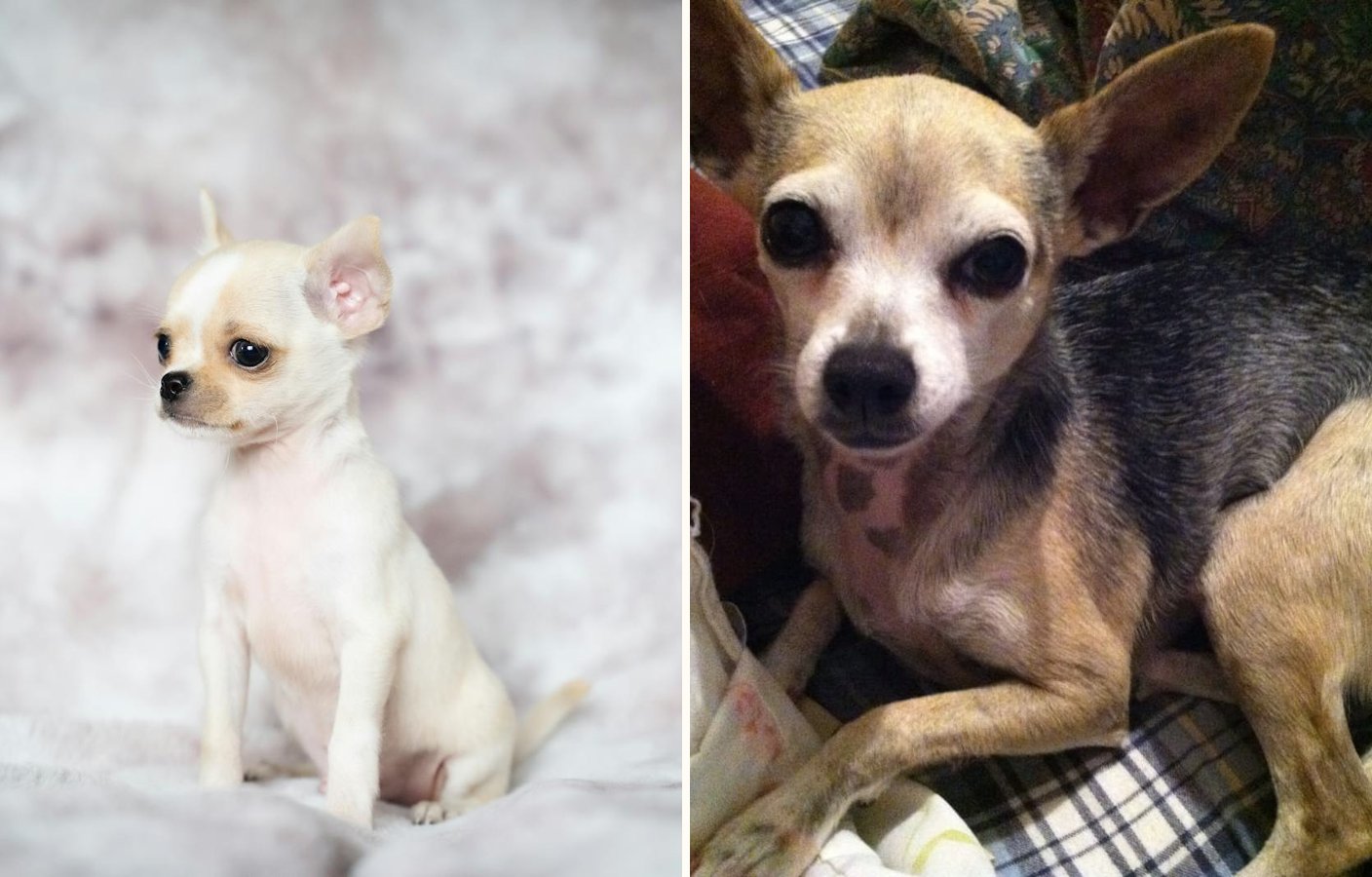
If you searched apple head vs deer head Chihuahua, you probably have a puppy in front of you and can’t tell which he is, or someone told you yours “isn’t purebred” because of his long muzzle. Let’s go step by step, because this topic has more myths than any other in the breed.
Short answer: they’re two head profiles of the same breed. The apple head is the one the standard describes and the one you see at shows; the deer head isn’t in the standard, but he’s every bit as much a Chihuahua. Our club has 160 registered members: 112 are apple heads and 48 are deer heads. Romeo and Lorenzo are both apple heads, and at family gatherings they mix with deer-head cousins without anyone noticing the difference.
How do you tell an apple head from a deer head?
Look at the dog in profile, not head-on. From the front, both have big ears and round eyes and you’ll get confused. From the side, the difference comes down to three things:
| Apple head | Deer head | |
|---|---|---|
| Skull | Round, domed, “like an apple” | Flatter and longer |
| Stop (the step between forehead and muzzle) | Sharp, almost 90 degrees | Gentle, sloping |
| Muzzle | Short, sometimes nearly snub | Longer and finer |
| Eyes | Very large, prominent | Large, less bulging |
| Neck and legs | Short, compact body | Longer, leaner dog |
| Typical weight | 3 to 6 lb (1.5 to 3 kg) | 5 to 10 lb (2.5 to 4.5 kg) |
| Molera (soft spot) | Common | Rare |
| In the standard | Yes (AKC and FCI) | No |
The trick I use with club puppies: rest a finger on the forehead and slide it toward the nose. If your finger “drops off” a ledge, it’s an apple head. If it slides down a ramp, it’s a deer head. Before 4 months, though, don’t trust it: many puppies are born with a round forehead and grow into a longer muzzle, and others go the other way.
Which one is the original Chihuahua?
It’s the most repeated question and it has a catch, because it assumes one of the two is “the real one.” It isn’t.
Today’s Chihuahuas descend from small dogs that existed in Mexico before the Spanish conquest, and when the first ones reached the United States in the late 1800s, both profiles were there. Photos from the 1920s and 1930s show round heads and long heads in the same litters. What happened next is what happens in every breed: the clubs wrote a standard, chose the round head as the desirable one, and for decades breeders selected dogs that had it.
So the deer head isn’t “the original” or “a degeneration.” It’s the profile the standard left out. Our Chihuahua history covers the rest of the journey.
What does the official standard say?
The AKC standard describes “a well rounded ‘apple dome’ skull, with or without molera,” a well-defined stop and a moderately short muzzle. The FCI standard, which governs in Europe and Latin America, says the same in other words: an apple-shaped skull as a breed characteristic. Neither mentions the deer head, and a judge penalizes it as a lack of type.
Two clarifications that matter:
- “Standard” isn’t the same as “purebred.” A deer head Chihuahua with registered parents has papers and is as purebred as any champion. What he can’t do is win a show.
- The molera (that soft spot on the skull, like a baby’s fontanelle) is accepted in the standard. It’s far more common in apple heads, and in most it closes or shrinks in the first months. If it’s still large at 6 months, the vet needs to rule out hydrocephalus.
How big does each one get?
Both finish growing between 9 and 12 months; there’s no difference there. The difference is in final size. A show-line apple head usually lands between 3 and 6 pounds, because that’s what he was bred for. The deer head tends to run bigger, 5 to 10 pounds, with longer legs and neck, and an 11-pound one isn’t unusual.
Watch the reverse logic: being big doesn’t make him a deer head, and being small doesn’t make him an apple head. There are 4-pound deer heads and 9-pound apple heads. To find out how big yours will get, the Chihuahua weight calculator estimates it from today’s weight using the breed curve, and when do Chihuahuas stop growing has the month-by-month chart.
Which one is healthier?
Here head shape does matter, and it’s worth saying plainly: the short muzzle and domed skull bring problems the deer profile doesn’t have, or has less of.
More common in apple heads:
- Open molera and hydrocephalus. A soft spot that never closes is the doorway to a hydrocephalus diagnosis, which is more common in this breed than in almost any other.
- Crowded teeth. The same 42 teeth in an even shorter muzzle: tartar earlier, lost teeth earlier. Why that shortens life is in how long Chihuahuas live.
- Tear staining. The prominent eye and shorter tear duct drain worse. We cover it in Chihuahua tear stains.
- Reverse sneezing and snoring. The soft palate ends up long for such a short muzzle.
- Exposed eyes. More risk of ulcers and, with a knock, of proptosis.
Shared by both, because they depend on size, not head:
- Luxating patella, the breed’s number-one orthopedic problem.
- Tracheal collapse, made worse by a collar. Harness, always.
- Mitral valve disease from about 7 or 8 years old.
- Hypoglycemia in puppies and very small adults.
Neither profile is sickly by definition. Romeo, a textbook apple head, is 11 and has only ever visited the clinic for checkups. But if you’re choosing a puppy and don’t care about looks, the deer head starts with a few fewer chips against him.
Which one costs more?
The show-line apple head, sometimes by a lot. It’s what the market pays for, because it’s what wins in the ring and what shows up in photos. The deer head usually costs less, and some breeders sell him as “pet quality,” which has no health or genetic basis whatsoever.
If you’re buying, what should move the price up or down are other things: patella and heart testing on the parents, socialization, a contract with a guarantee. We list them in how much does a Chihuahua cost. And be wary of any “teacup apple head” at a premium price: that’s marketing, not a variety.
Can apple heads and deer heads be bred together?
Yes, and it happens all the time, because they’re the same breed. What you can’t do is predict the result. Skull shape depends on several genes at once, so an apple-to-deer litter can produce puppies of both types and many in-betweens, with a half-marked stop and a muzzle that’s “neither short nor long.” And those in-betweens are, in practice, most pet Chihuahuas.
So if a breeder promises you a “guaranteed apple head” at 8 weeks, he’s guessing. The final profile shows up between 4 and 6 months.
Apple or deer head with long hair, black, chocolate…
Head type is independent of coat and color. There are long-haired deer heads and short-haired apple heads, black deer heads and chocolate apple heads, and every combination. If you want to see each variant with photos of real club members, our guide to the types of Chihuahua has them all, and Chihuahua colors explains which gene produces each one.
What actually matters
After 160 members and two Chihuahuas at home, my take is this: the head tells you what the dog looks like and a little about which problems to watch for. It tells you nothing about what living with him will be like. Lorenzo and his deer-head cousin have exactly the same electric temperament, the same habit of barking at the elevator and the same talent for burrowing under the same blanket.
Choose by the parents’ health, by socialization and by how he looks at you. Apple or deer, he’ll follow you to the bathroom either way.
This article is informational and doesn’t replace a consultation with your vet.
Frequently asked questions
What's the difference between an apple head and a deer head Chihuahua?
Which is the original Chihuahua, apple head or deer head?
How big does a deer head Chihuahua get?
Are deer head Chihuahuas healthier?
Can a deer head Chihuahua be shown?
If I breed an apple head to a deer head, what do I get?
Written by Belen Salto, who shares her life with Romeo and Lorenzo, two Chihuahuas. · Ver en español